Sci-fantasy is apparently a new genre which mixes science fiction and fantasy - two genres which are often confused but which are utterly different.
Dragon of the Second Moon is Australian writer Christian Taamblyn's first novel and occupies this fresh, hybrid space, though leaning heavily on the latter.
THE GOOD BITS
Featuring linguistic flaws of the novice writer - choppy sentances, an excess of adjectives, and a few punctuation missteps - this book is nonetheless an engaging read. I've definitely read - and written - much worse, language-wise. My expectations that the protagonist, Alex (later renamed), would turn out to be a messianic character falling just shy of a Gary Stu were pleasantly unfulfilled. Mistakes, misunderstandings and hardships plague him as any fish out of water. Taamblyn's time compression of the character's learning curves are masterful - without being bored by every minute ticking past, we are given a few paragraphs of explanation which manage to express the amount of time and effort Zanderhall puts into his re-education. The bewilderment, wonder and loneliness of the character comes across well without making him a pathetic character. Learning a language, learning to fight, learning to use magic - these things all take time and effort (well, I wouldn't know about the last one but I assume so) and this is expressed in a realistic manner, rather than just "oh hey I picked up a whole vocabulary in a week and look at my awesome firebolts". It's nice to see a bit of realism trumping a faster-paced, action-packed story. Not to say this isn't fast-paced and action-packed, because it is.
The novel provides a thoughtful perspective on cultural divide, which has two peoples - magical and non-magical, essentially. The non-magical folk are suspicious of their counterparts, who have their ears cut to 'mark' them and are then ostracised. This segment of the population have formed nomadic tribes of people far more 'in tune' with the world than their stodgy, city-dwelling counterparts. The cultural and lifestyle differences that result are well-crafted and provide nice contrast.
Taamblyn weaves some stock fantasy archetypes into this story with accumen, providing some interesting new pespective which tailors the creatures to his world: elves, mermen, dragons, dryaads, were-creatures, even a Minotaur-like creature. I was continually surprised and delighted at how Taamblyn appropriated tried-and-true 'species', not completely deviating so that they were entirely new creatures with a new name, or just re-using the same-old; he really integrated them into the heritage and atmosphere of the story. They fit well, it wasn't just an "insert elf/dragon here" or worse, "well we'll call it a Minotaur because it's similar even though it flies against all of the preestablished norms of the creature" (yeah Smezzer, I'm looking at you).
One of the main difficulties with giving one race, or even a group of characters magic (or mar'jics) is that you give them a a rather large advantage over the non-magical folk. Taamblyn ties magic into mythology and makes it a skill, to be honed and practised, rather than some mystical, disconnected skill. Through the main characters' eyes, we witness some Eleran children being taught how to focus their innate powers (p102). It's a wonderfully crafted bit of world-building. Complicated, powerful magic takes a physical toll on the wielder, which means warriors still have a part to play, and necromancy is pretty much out of the question. These are sensible but often overlooked 'laws' of fantasy.
THE IFFY BITS
My only real disappointment is that Taamblyn has fallen into the trap that nearly all fantasy writers do: sidelining female characters and perpetuating ridiculous gender standards. Taamblyn sets up this seemingly equal society by giving the Eleran people a Queen. He promptly turns around and negates that with Sharna, a character whose sole function is Protaganist's Love Interest and Paragon of Sexual Liberty. Then there's physically dimunitave Kyanne (p152), and brash, outspoken Gail, who are the only two women pointed out among the fighters though in Gail's own words, "Scores of those going North [to fight] will be women. We will fare no better or worse than the rest, be treated as equals" (p316). This forward-thinking statement is immediately sidelined three pages later where we are treated to a voyeuristic affirmation of Gail's feminity, as she undresses in a tent, emphasising the "shapely curve of her ample breasts, even the fine definition of her waist, hips and legs" (p319). It just felt completely unneccesary and quite belittling to the character.
In two instances - there may be more, these are just the ones that stand out - senseless Western male stereotypes are also integrated into the story - Jahlam's refusal of a numbing paste on his ears before he was marked because "it was not the manly thing to do" (p94). That sentance infuriated me. Further on, a (male) character speaking of his lost daughter and grandson gets (understandably) teary-eyed. "He quickly turned his head to conceal his weakness" (p286). Sorry, what?! He's lost his family and he's upset. I'd be more concerned if he DIDN'T react emotionally. Why is this a 'weakness' when Kyanne cried "in heavy sobs" (p159) after winning the right to be a Loremaster? Hello, sexism which does not need to be in a fantasy book. I know I harp on about it a lot, but where there's magic and dragons and swords, is it really that difficult to have women fighting and guys crying and, y'know, aspects of social gender equality which are sorely absent from the real world?
Don't even get me started on page 212.
I was discussing these issues with my boyfriend, as I really do like the book and didn't want to be too harsh on it because of its shortcomings. He said, "honestly I don't think that most authors think about the gendered implications when they write. They're more focused on the characters as individuals and the plot movement." Which is fair and probably true, but like I said to him, the tent scene and the two statements about manliness and weakness stick out like a sore thumb. The book would have gone through several rewrites and the fact that those sections - not contributing to overall plot, storyline, or character development - are still there means that they were consciously included. I could of course be wrong, that's just the impression that I get.
TL;DR
Gendered stereotypes aside - and hey, these sorts of issues may not phase you, and fair enough, it's very common in the genre - I actually do like this book! I know I did a massive breakdown of the 'iffy bits', but that's what an English degree does to you. Makes you super-critical. When I met Christian at Supanova he seemed like a really nice guy. The sequel will hopefully be out soon, and I will definitely be purchasing a copy. If you can get your hands on the book (it's at Borders and online at his site) I'd definitely recommend it. For fans of sci-fi AND fantasy.
Showing posts with label reading. Show all posts
Friday, December 3, 2010
Sunday, November 28, 2010
New Project!
I've finished uni and work's not being too liberal with shifts (for me, anyway) so I'm finding I have a lot of free time on my hands. Struggling with ideas that don't require lots of moolah (see above re: not a lot of work), I've decided I ought to do some more reading and reviewing. I am behind on my comic reviews, so I'll get to that, but I've decided to work my way through the Australian scifi/fantasy section of my uni's library, and my own bookshelf. I'm passionate about Australian authors (since I hope to be one :P) and even though my blog is mostly beauty (and that's a lot of fun!) I've decided to branch out a bit more. I'll also being doing some classics/'must-read' books. I just finished Life of Pi by Yann Martel. I'm going to re-read it before I review it, if I can manage to keep myself away from all the shiny new books I'll be getting tomorrow!
I will keep posting make-up and nail polish stuff, don't worry (I have a lovely big High Voltage Cosmetics order on the way)! And I still have my handy-dandy tags at the top of the posts, so you can see without having to read the post itself what it's going to contain.
Do you have a favourite book/series/comic? Please comment and let me know; if I can get my hands on it, I'll definitely read and review it! If you don't have any rec's, tell me what kind of info you like to see in book/comics reviews.
On my shelf (Aussie authors bolded):
The View From the Mirror quartet by Ian Irvine
Silverbirch by Rob Kaay
Dragon of the Second Moon by Christian Taamblyn done!
Dragonfly by Frederic S. Durban I'm dumb, and forgot I already did a review of this. Read it here. See how my blogging style has changed (heh). Then go get the book.
Dark Heavens trilogy by Kylie Chan
On my list:
Ansai Boys by Neil Gaiman
Life of Pi by Yann Martel (read)
My Last Duchess by Ian Crichton Smith (read)
Comics:
Serenity: Shepherd's Tale
Artifacts #1
Kill Shakespeare #3-#6
Chew, vol. #1 & #2
Deadpool: Pulp, #1-#4
Changing Ways, volume 1 done!
Deadpool: Wade Wilson's War done!
I will keep posting make-up and nail polish stuff, don't worry (I have a lovely big High Voltage Cosmetics order on the way)! And I still have my handy-dandy tags at the top of the posts, so you can see without having to read the post itself what it's going to contain.
Do you have a favourite book/series/comic? Please comment and let me know; if I can get my hands on it, I'll definitely read and review it! If you don't have any rec's, tell me what kind of info you like to see in book/comics reviews.
On my shelf (Aussie authors bolded):
The View From the Mirror quartet by Ian Irvine
Silverbirch by Rob Kaay
Dark Heavens trilogy by Kylie Chan
On my list:
Ansai Boys by Neil Gaiman
Life of Pi by Yann Martel (read)
My Last Duchess by Ian Crichton Smith (read)
Comics:
Serenity: Shepherd's Tale
Artifacts #1
Kill Shakespeare #3-#6
Chew, vol. #1 & #2
Deadpool: Pulp, #1-#4
Labels:
blog note,
comics,
life stuff,
reading,
reviews
Sunday, October 10, 2010
More thoughts on Ebooks
In response to my post Thoughts on: Ebooks, my writing and reading friend The Incredible Rambling Elimy has done her own post. A sort of rebuttal. I do agree with many of her points, but I shan't steal her thunder :)
Monday, October 4, 2010
Thoughts on: eBooks
Recently, ebooks and ebook readers have begun to intrude on my world. Well, maybe 'intrude' isn't quite the right word. It first started in class, when we were discussing the cost of our books for a literary unit, after discovering that a play we had all paid $20 for was available for free download online (yes, legally!) Our tutor wondered aloud why the university didn't provide ebooks for students, to lessen the sometimes ridiculous costs of texts and readings.
Secondly, a book blogger that I love to read has just bought an ebook reader and is documenting her experience with it. Her reviews are wonderful, completely out of my usual genre (which is good), and she's Australian which I like because it means I know the books she reads will be available to me.
Thirdly, after ogling the Kobo in Borders, I discovered that there's a Kobo app available for the Blackberry!
I promptly downloaded it (it's free) and started browsing. Kobo have a 'free classics' section so I was able to download a few of the titles that have been on my "I need to read these one day" list: Moby Dick, Ulysses, The Phantom of the Opera. I also downloaded some T.S. Elliot, and out of curiosity, Little Vampire Women. Then lo and behold, I stumbled across, in the free classic section, the sequel to one of my beloved op shop finds called The Princess and the Goblin! I couldn't believe it. It's one of my favourite old books, just beautiful and fantastical, and there was the sequel, right there, for free. Truly an amazing moment!
Obviously reading on my Blackberry is very different to reading on an ebook reader or even an iPhone, since my display screen is quite small, but the formatting of the ebooks I have read so far (Little Vampire Women, which I might review later, and about half of The Phantom) makes it actually pretty easy. Paging is quick and efficient, and it's simple to bookmark the page you're on if you need to exit the app to use your phone for anything else. Reading Phantom has been a little challenging because of the footnotes - they all get stuck on a seperate page, so you literally find yourself reading a page of footnotes in between the actual story. It's a bit disconcerting. However most contemporary books don't have footnotes, so I don't think that will be a problem I encounter again.
White version of the Kobo, and no that is not a picture of my Blackberry, I was too lazy to take one! I have that silicone skin though, mine is purple.
I really like that you can still see the covers of the books when you're browsing - in fact, if you like to go against the popular adage and judge a book by it's cover, you can choose to just view covers in Kobo, instead of seeing the title and rating.
For a student working casual hours, the price of ebooks versus print books is a huge factor for me. Buying Little Vampire Women in Borders would have cost me $24.95. The ebook version? Just $5.80!
My one gripe with the Kobo app so far is that it doesn't tell you whether or not an ebook is available to Australians until you're about to purchase it. There were several other titles I was interested in as a 'test run', before I ended up purchasing Little Vampire Women. The only other downside so far is the time factor: I am a very fast and proficient reader; I can tell (roughly) the amount of time it will take for me to read a book just by looking at the page numbers. With ebooks, you can look at the 'contents page', but my sense of time is completely thrown. Also since it's much easier to sneak in a chapter here and there, I can't tell you exactly how long it took me to read Little Vampire Women. It might be less time than the paper version, it may be more. The general consensus by those who have bought ebook readers is that they read faster, though.
What is really winning me over is the fact that I no longer have to worry about books being sold out, or out of print, or needing to be shipped which means A) paying shipping and B) waiting for it to be shipped. I just searched Louisa Alcott (the author of Little Women) and discovered that, besides Jo's Boys (which I was incredibly lucky to have found in an op shop), Alcott wrote several other books about the March family!
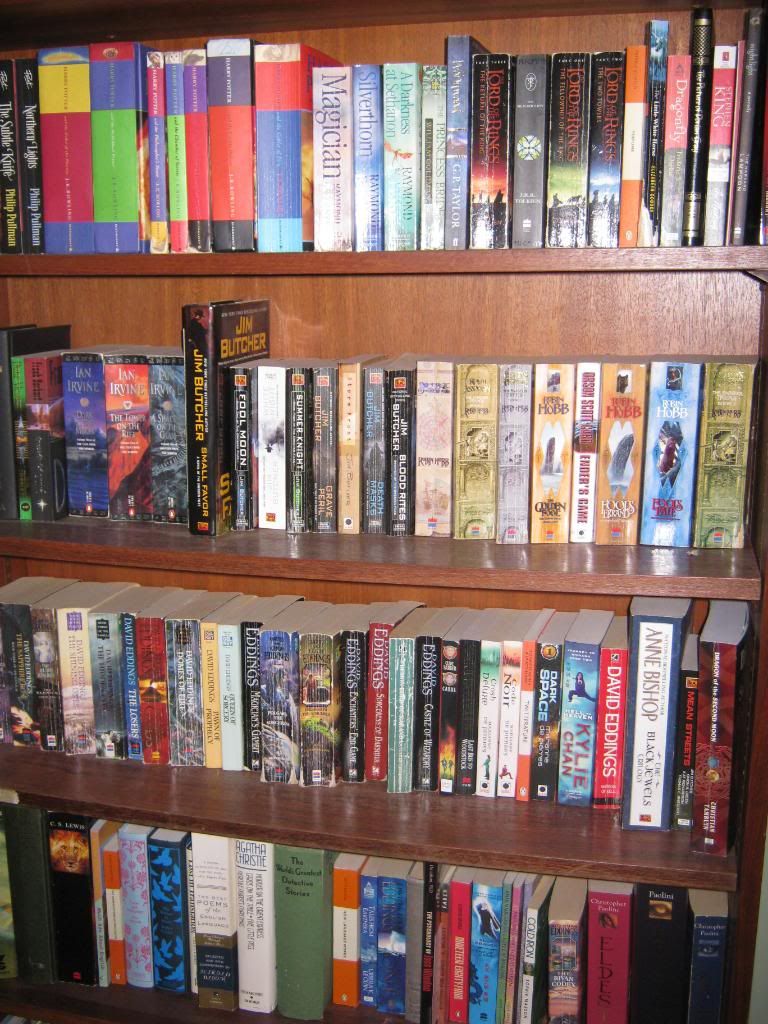
Don't get me wrong, I'm not going to run out and buy a Kobo just yet, though I do reccommend them if you're curious like me, since you can use it (again, for free) on your computer if you don't have a smartphone. You can share the account/library between your Kobo, phone and computer, which means reading anything, anywhere, any time. I still love paper books and will still buy them, I just think the Kobo and all its software is a great option for people who can't afford to buy books all the time, want more portability. I mean, look at my bookshelf:
That is just my fantasy/scifi section. There's another shelf under that one down the bottom, and then I have a second shelf unit, same dimensions, filled with other genres, and with my comics and encyclopaedias on the doubly-tall bottom shelf! So there's no way I'd give up on paper books. I love them too much. That being said, I'm not completely against ebooks any more, now that I realise how useful they can be.
Have any of you tried ebooks? What do you think of them?
Thursday, September 2, 2010
Sympathetic deja vu
DISCLAIMER: this is a very personal post. It is not meant to be construed as advice, I have not scrambled to be politically correct, I am not saying that this is what "should" be done. This is an account of my own experience, my own thoughts on the subject, and I ask that you respect that.
* * *
At uni this semester, I am doing a course called 'world writing today'. We were asked to read a play called 4.48 Psychosis, by Sarah Kane. The format of the script was not traditional. I had no idea how it would translate to stage at all, and as such ended up reading it like a poem. It was so hard for me to read. Not just because it was odd, dark and violent... but because those qualities reminded me of the poems I used to write when I was suffering from depression.
I'm saying this right now: I am not comparing myself to Kane's literary or dramatic merit. Ok? The reason that I so much identified with her work is the emotion; her use of visual poetry format; her wordplay, rich in alliteration, repetition, and strongly physical imagery. When I read her words, I could feel them roiling in my stomach and twisting through my veins like the words I used to try and exorcise my own demons with. It's awful, but I miss that... burn, that rush when it felt like I was able, with pen or keyboard, to bleed a little of my own darkness into form. My quality of life, and my relationships, are immeasurably better. My anxiety levels are that of a normal person and I'm utterly grateful for it. Medication and therapy helped me to cope, helped me to enjoy life rather than feeling like I failed miserably at everything and shouldn't have been born. The feelings that I needed to explain are, for the most part, gone... But I still miss the relief and the exhilaration of being able to put them on the page. Does that make sense? I am a writer, and I have in essence, lost a part of myself. But it was the emotional equivalent of a gangrene limb: not having it makes me happier and much healthier.
I want to read more of Sarah Kane's work, but I don't know if it's a good idea. A few months ago, my desire to write poetry again drove me to stop taking my medication. I crumbled like a derelict house. My emotional equilibrium was gone. I became so despairing and at times hysterical. I cried nearly every day. Work was unbearable. I hated the way I behaved towards my family, my friends and my boyfriend. I went back on the medication. I never even wrote anything during that period. My brain was so freaked out by the resurgence of my chemical imbalance, I did not know how to cope with it at all. Any and all tolerance I had built up over
the years was gone.
Funnily enough, we discussed this connection between creativity and mental illness in class. It was my second tutorial (I missed a week when I was fluey) so I was totally uncomfortable and didn't mention my affinity with Kane's work, my conflicted reaction to it or my personal experience with the subject of our discussions.
The fact that I take antidepressants is not something that I really share with people. Depression has been such a 'popularised' condition that it's almost something not taken seriously any more. Yes, some doctors are more quick to prescribe antidepressants to people who are lethargic, going through a rough time or have other conditions. But for me, personally - I was significantly depressed and anxious from the age of twelve onwards. I did not seek professional help until I was seventeen. I utterly resisted the idea of medical or psychological help, even after that. When I finally went to the doctor, nineteen and desperate, it became clear within a month that my problem was a chemical imbalance. However, I had mental and emotional habits which lingered after the medication, so reluctantly accepted, had stablised my emotional state.
Thinking back, it's easy to see why I didn't really want help for so long. I wasn't ready to let go of the pain, which utterly defined me. I was scared of what I would be without it. I was afraid of losing myself, or at least a part of me, if and when the pain went away (not that I could imagine what that would feel like). We humans don't like change, even if we know that it's a change for the better. It's scary. To accept help with dealing with depression and anxiety is inviting a massive change into your life.
Sarah Kane's work, and her story, is just as wrenching as that of the better-known Sylvia Plath (I have not read the Bell Jar: same issue. I would love to read it but I am afraid it will be too triggering for me). Psychosis was actually completed, and delivered to her agent, two days before she killed herself. Some critics and academics have labelled the play her suicide note. While it is raw, shockingly emotive and confronting I think labelling it a suicide note takes away from the fact that it is art. It has all the qualities of a piece of art, but even the first page tells you that this is not just some fictive piece, an imagined world. With 4.48 Psychosis, Sarah Kane brought her world of chaos, pain and loss onto the page, so that it may be translated onto the stage. So that maybe someone would understand, and maybe... maybe then she wouldn't be so alone with her perception of the world. That's what I felt like when I wrote. Yet... after opening herself up to the world this way, she ended her life. I still don't know what to make of that.
Further reading about Sarah Kane here.
Downloadable and free copy of 4.48 Psychosis here, if anyone is interested in reading it.
My previous post about artists and suicide here.
Labels:
depression,
life stuff,
opinion,
reading,
university,
writing
Friday, July 9, 2010
Review: The Book Thief
Me stuff:
I'm not a fan of historical fiction. It just hasn't ever appealed to me. Thus, I put off reading this book, set in 1939, Nazi Germany, even though a friend had sung its praises and insisted I take her copy home to read. I'm ashamed to say that the book sat forlornly on my dressing table for a good number of weeks. Whenever it would catch my eye, I found something else to occupy myself with. I finally picked it up one weekend when I knew I'd been on a train for a total of three hours (to work, to boyfriend's family's house, back to work, back home).
The actual book review:
Although The Book Thief displays many of the conventions of historical fiction, I wouldn't call it that. The label is far too restrictive. The novel contains a story as amazing and as lushly descriptive as any epic fantasy I have read. It contains dazzling pieces of humanity, hidden in the sweat and grime of Nazi Germany, and reflected in the eye of a very unique narrator. The characters in this book cry and run, eat and sleep, think and dream in its pages and as you read, you feel every bit of it. Though the characters in the book have to deal with the horrible crimes and inhumane behaviours of 1939 Germany, I wouldn't call this a 'Holocaust book' at all. The story just happens to take place in Germany during the Holocaust. Don't get me wrong, the issues are not made light of in any way - the characters experience all the violence and racism, it just isn't the main focus of the book. I can't comment on any historial inaccuracies, and twenty minutes of Googling didn't show anything either so I assume it's more or less factually legitimate.
Markus Zusak's technique goes beyond wordplay - I would unreservedly call him a true wordsmith. His phrasing and language are so new, and are yet so perfectly fitting that you marvel, "why did nobody think to put it that way before?" I would re-read his book just for the way he writes, but what he writes is just as beautiful and heart-breaking. The language just enhances it.
If I like a book, usually I tear through it, desperate to sate my curiosity and to 'keep up' with the narrative. This book created a whole new reading experience for me - I read it over a period of four days. The book is 584 pages long, something I'd usually polish off in a single day. The narrator frequently 'spoils' future events for you. This changes the whole experience you have as a reader - you know what's coming, so you're waiting for it, but it's not unbearably tense, or conversely, boring. The bits in-between major events are just as beautiful and vital - every word is precious, so there is no temptation to skim or skip. Whilst there are major and minor events in the book, every paragraph is vital to the story. There is no filler, no supurfluous background, no descriptive swamps. Each sentance is there because it needs to be; it is a brick in the wall, that if it were to disappear, would cause the wall to crumble and fall.
Maybe it's this altered sense of tension that allowed me to put the book down and mull over what I'd already read, without feeling as though I were missing out on things. I do think it had a lot to do with the way Zusak writes, the spellbinding yet simple way he describes everything, from clouds, to pain, to stale biscuits. His wording is striking in its ingenuity and so tangible. I will read this book again, many times. I plan on buying my own copy and putting it on the shelf with my other favourite novels.
The Book Thief is not quite an adrenaline-spiking adventure book, or a glittering fantasy, or a cerebral science-fiction book that you can pick up and put down with nary a thought. It's not an 'entertainment' book to pass the time with. It's painfully, exquisitely real, and I need to breathe and think for a little bit before I immerse myself in it again. It is a book that will sink itself into you and never quite let go. I would say go out and buy a copy right this second if you can, for the sheer quality of the writing, but make sure you're ready to be intellectually and emotionally stirred before you pick it up.
I have heard (and read) that in America (well, North America at least) The Book Thief had been released as a 'young adult' fiction book. This baffled me. I mean, sure, the main character is a young girl, but I wouldn't classify this as YA at all. It's like George Orwell's Animal Farm, or Frederic S. Durbin's Dragonfly (my review of that here), in that although by dint of the blurb it sounds as if it is intended for a younger audience, the content is definitely something you need a level of maturity to properly absorb and appreciate.
The differeces between the Aussie cover (left) and what I assume is the US cover (right) are fascinating:

In some of the reviews I read, there was some pretty heavy-duty cover analysing done. I think it's a somewhat iffy thing, personally, as authorial control over what goes on the cover varies so wildly. Some authors are so involved, they design or draw their own, whereas others don't see the finished product until it goes onto bookshelves. That being said, I do love the Aussie cover, and I think it represents the book far better than the other one. Aren't dominoes cliche yet?
Author info:
Considering both the subject of the book, and the international acclaim of the author, I was surprised and delighted to find that Markus Zusak is Australian. Another ray of light for those of us Aussies who have been 'bit by the writing bug'! Zusak is the child of one German and one Austrian immigrant, which would explain his fascination with the subject and would have no doubt helped him with the German language, emotional and historical accuracy of the book.
To date, Zusak has written four other books, with one, Bridge of Clay, due out in September this year. His Wikipedia page has his bibliography. The next most renowed book of his is The Messenger, which I'd definitely like to read before the new one comes out.
Links:
Here is a quick little interview with Zusak by the UK Guardian.
Here is his official Random House page.
A review by UK's The Independant.
A review by the New York Times.
Subscribe to:
Posts (Atom)