Showing posts with label technology. Show all posts

Monday, October 4, 2010

Thoughts on: eBooks

Recently, ebooks and ebook readers have begun to intrude on my world. Well, maybe 'intrude' isn't quite the right word. It first started in class, when we were discussing the cost of our books for a literary unit, after discovering that a play we had all paid $20 for was available for free download online (yes, legally!) Our tutor wondered aloud why the university didn't provide ebooks for students, to lessen the sometimes ridiculous costs of texts and readings.

Secondly, a book blogger that I love to read has just bought an ebook reader and is documenting her experience with it. Her reviews are wonderful, completely out of my usual genre (which is good), and she's Australian which I like because it means I know the books she reads will be available to me.

Thirdly, after ogling the Kobo in Borders, I discovered that there's a Kobo app available for the Blackberry!

I promptly downloaded it (it's free) and started browsing. Kobo have a 'free classics' section so I was able to download a few of the titles that have been on my "I need to read these one day" list: Moby Dick, Ulysses, The Phantom of the Opera. I also downloaded some T.S. Elliot, and out of curiosity, Little Vampire Women. Then lo and behold, I stumbled across, in the free classic section, the sequel to one of my beloved op shop finds called The Princess and the Goblin! I couldn't believe it. It's one of my favourite old books, just beautiful and fantastical, and there was the sequel, right there, for free. Truly an amazing moment!

Obviously reading on my Blackberry is very different to reading on an ebook reader or even an iPhone, since my display screen is quite small, but the formatting of the ebooks I have read so far (Little Vampire Women, which I might review later, and about half of The Phantom) makes it actually pretty easy. Paging is quick and efficient, and it's simple to bookmark the page you're on if you need to exit the app to use your phone for anything else. Reading Phantom has been a little challenging because of the footnotes - they all get stuck on a seperate page, so you literally find yourself reading a page of footnotes in between the actual story. It's a bit disconcerting. However most contemporary books don't have footnotes, so I don't think that will be a problem I encounter again.


White version of the Kobo, and no that is not a picture of my Blackberry, I was too lazy to take one! I have that silicone skin though, mine is purple.

I really like that you can still see the covers of the books when you're browsing - in fact, if you like to go against the popular adage and judge a book by it's cover, you can choose to just view covers in Kobo, instead of seeing the title and rating.

For a student working casual hours, the price of ebooks versus print books is a huge factor for me. Buying Little Vampire Women in Borders would have cost me $24.95. The ebook version? Just $5.80!


My one gripe with the Kobo app so far is that it doesn't tell you whether or not an ebook is available to Australians until you're about to purchase it. There were several other titles I was interested in as a 'test run', before I ended up purchasing Little Vampire Women. The only other downside so far is the time factor: I am a very fast and proficient reader; I can tell (roughly) the amount of time it will take for me to read a book just by looking at the page numbers. With ebooks, you can look at the 'contents page', but my sense of time is completely thrown. Also since it's much easier to sneak in a chapter here and there, I can't tell you exactly how long it took me to read Little Vampire Women. It might be less time than the paper version, it may be more. The general consensus by those who have bought ebook readers is that they read faster, though.

What is really winning me over is the fact that I no longer have to worry about books being sold out, or out of print, or needing to be shipped which means A) paying shipping and B) waiting for it to be shipped. I just searched Louisa Alcott (the author of Little Women) and discovered that, besides Jo's Boys (which I was incredibly lucky to have found in an op shop), Alcott wrote several other books about the March family!

Don't get me wrong, I'm not going to run out and buy a Kobo just yet, though I do reccommend them if you're curious like me, since you can use it (again, for free) on your computer if you don't  have a smartphone. You can share the account/library between your Kobo, phone and computer, which means reading anything, anywhere, any time. I still love paper books and will still buy them, I just think the Kobo and all its software is a great option for people who can't afford to buy books all the time, want more portability. I mean, look at my bookshelf:
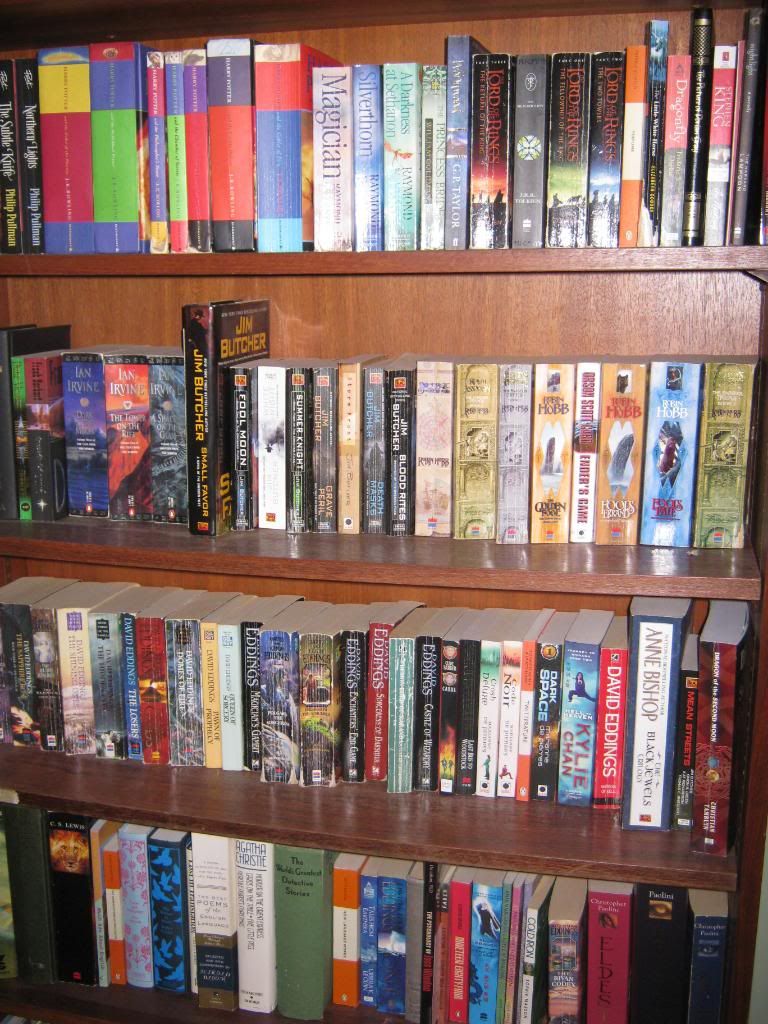

That is just my fantasy/scifi section. There's another shelf under that one down the bottom, and then I have a second shelf unit, same dimensions, filled with other genres, and with my comics and encyclopaedias on the doubly-tall bottom shelf! So there's no way I'd give up on paper books. I love them too much. That being said, I'm not completely against ebooks any more, now that I realise how useful they can be.

Have any of you tried ebooks? What do you think of them?

Monday, September 6, 2010

Social Media Musings

Facebook, Twitter, MySpace, and to a lesser extent, Tumblr, Flickr, and blogging platform sites (blogger, wordpress): what do they all have in common? They fall under the category of social media. They condense our social world, bringing us together globally like never before. Are you as tired of hearing terms like "global village", "global economy" and "OMG the internet totally brings us together lol" as I am? Yet, it's still a subject that bears some examining, because it has changed us, both on a global and individual level. It's had a huge impact on the way we relate to each other. Sites like Facebook and MySpace have a different dynamic to the rest because they ask for real information - they (supposedly) reflect and enhance our real life 'connections', though more and more, through gaming, pages and groups, they are connecting people who would not have met off-line, who now connect through text and trawl each others photos even though they have never, and probably will never meet face-to-face. Forums, blogging, Tumblr and to a lesser extent Twitter, are more anonymous - they provide a platform for virtual relationships to blossom, where people know each other by nicknames and handles and may not, for months, or ever exchange photos and 'real' information, though they consider themselves friends.

The dynamic of these virtual relations are a little odd, if you think about it. The way we relate to each other online is markedly different to our 'physical-world' way, but we don't really think of it in those terms, do we?

Let me attempt to break it down, to compare it step-by-step, so to speak:
ONLINE
1. Two people meet, say on a forum. They would probably post in many of the same threads, directing comments at and referring to each other. They might read each other's post history to try and get a better sense of one another.
2. A private message may be sent, asking a question or proferring a comment, funny link or piece of information.
3. The two may arrange to meet online somewhere that they can chat in 'realtime'. This may be an independant chatroom, an email-based host such as MSN.
4. Cross-connection would begin; they would refer each other to the other social media sites that they use.
5. Facebook identities would be the final point of the connection - giving each other access to real names, photographs, and real-life friends.

OFFLINE
1. The two people meet, say at a party. They will likely be introduced by a mutual friend. They talk, exchange stories, and by the end of the night will likely exchange phone numbers or email.
2. A mix of private and group interactions will now take place. The two new acquaintances will text and/or email each other, and probably go out with the mutual friend. They will begin to get to know each other independant of the mutual friend.
3. They will connect on Facebook, looking at photos, social history, likes and dislikes.
4. Now this relationship can go one of two ways: either the relationship will develop online, offline, a mix of the two, or it will not develop at all, and they will remain at the acquaintance stage.

FACTS
Mentally and emotionally, humans are capable of maintaining only 150 relationships offline. Some sociologists are claiming that Facebook, whilst it does not help us expand that number, helps maintain 'weak ties' we would not ordinarily be able to have head-space for. I like to call this, very un-scientifically, the "Huh! I remember that person!" factor. People you knew in school but weren't close to, people you used to work with, ex-next-door neighbors, that sort of thing. People you wouldn't object to keeping in contact with, but somehow, you never quite made the effort to connect with them. These are your 'periphary' relationships. These are the people that are friends with us on Facebook, but there's no wall-to-wall talking. Maybe just a quiz invite or two.

Our circle of real, close friends is often very small. These are the people we will cry in front of, the people we may fight with, the people we want to tell important news to first, the people to whom we say, "Stop working so hard, I never see you any more!" and actually mean it. If I'm going to be brutally honest, I probably only have three of these sorts of friends, and one of these is my boyfriend, so he's in a category of his own. These people may actually not Facebook/Twitter with us very often - because they're so often with you, or you already called them and told them things that it would just be overkill to talk about it online!

Then there are the people that, for reasons of time, distance and scheduling, have the potential to become one of the really close friends. These are the people we really like spending time with, and have lots of thing sin common with, but aren't totally comfortable telling them all of the intimate details of our life yet. They may eventually become part of our 'inner circle', but for now multiple coffee dates and lunches giggling over TV series are the go. These people are probably very present in our online lives, where you chat and arrange meetings through tweets and messages.

Online friends, people who you meet through games, forums, blogs etc. may never hear your voice, due to the security risks and costs inherent with talking to a stranger on the phone. However, Skype, saviour of many long-distance relationships, is changing this. Some friends may be content with text-only relationships conducted through every social media available, but those who aren't may now talk aloud with new-found cross-Atlantic pals. These people, naturally, will be very present in your 'online' life and activities, because it is their primary form of contact with you.

As a media student with a very basic, amateur interest in sociology, I find the subject of technological impact on human relationships quite fascinating. It's also especially helpful in diffusing the grumbling surrounding how 'wired in' Gen X and Y are ;)

So... yeah. This post started off all nice and decisive and degenerated into me rambling and providing bad examples. SORRY!


LINKS  (stuff I read that gave me ideas)
http://stream.adamdodson.org/items/view/3010
http://technosociology.org/?p=131
http://www.news.com.au/technology/kates-party-prank-takes-aim-at-facebook-privacy/story-e6frfro0-1225858792605
http://www.adelaidenow.com.au/news/world/embarrassing-web-data-may-cause-users-to-change-names/story-e6frea8l-1225907968537
http://www.socialtimes.com/2010/08/google-change-your-name/
http://social-networking-tagging.suite101.com/article.cfm/difficult_facebook_relationship_status_changes
http://cow.neondragon.net/index.php/sociologists-describe-facebook-ambient-awareness
http://www.telegraph.co.uk/technology/news/7066454/Facebook-friends-are-virtual-finds-Oxford-University-study.html
http://mashable.com/2009/10/16/social-media-changing-lives/
